Standard Physics Explanation
In standard physics, time is commonly treated as a coordinate, parameter or dimension used to order events and measure change. In classical physics, time is often treated as a background parameter. It is the variable against which motion, force, change and energy transfer are described. Objects move through space as time passes, and time provides the ordering of before, now and after. In relativity, time is joined with space as spacetime. An event is placed inside a four-dimensional structure using coordinates. Motion and gravity affect the way durations and distances are measured, and different observers can disagree about measured time intervals, simultaneity and path length. In this framework, time is not universal in the old Newtonian sense. It is part of the geometry through which events are described. This standard view is powerful. It gives us working equations for motion, gravity, light, time dilation, redshift, orbit prediction, black holes, cosmology and precision timing. It is the correct local measurement framework for many physical situations. But standard physics usually places time inside geometry. SCU asks a deeper question: What if geometry itself emerges from time?
SCU Explanation
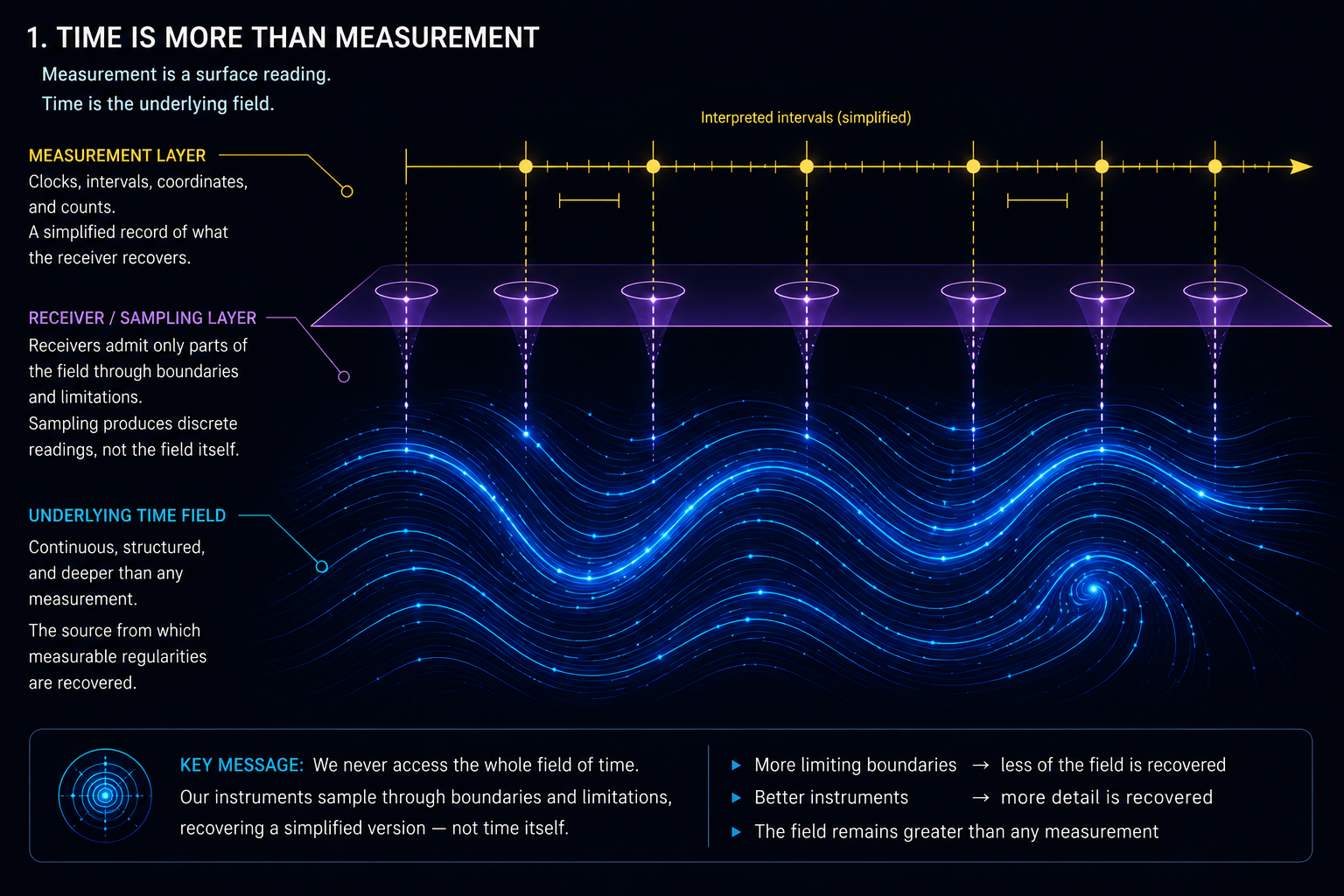
In the Structural Chronometric Universe, time is treated as the primitive analogue field. Space, matter, radiation, gravity and observation are not treated as deeper than time. They are interpreted as structures, gradients, folds, resonances or recoverable effects within time. Time is therefore not just a clock reading. It is not just a coordinate. It is not only a dimension added to space. In SCU, time is the field through which events form, persist, propagate and become recoverable to observers. This changes the order of explanation. Standard physics usually says: space and time form geometry, and events happen inside that geometry. SCU says: time forms structure, and stable recovered structure appears to us as geometry. In other words, geometry is not the deepest layer. Geometry is what a receiver recovers when the underlying chronometric field becomes stable enough to behave as measurable space, distance, duration and pathway.
Time and Geometry
In standard physics, geometry describes relationships between positions, durations, paths, curvature and motion. Time is one part of that geometric description. In SCU, geometry is emergent from the condition of time. If the chronometric field changes density, elasticity, coherence or flow structure, then the recovered geometry changes with it. Space is not treated as an independent empty container with time added to it. Space is the stable recoverable shape of time. This means that distance, duration, curvature, redshift, delay, lensing and propagation are not only geometric effects. They are also chronometric effects. They describe how event-memory survives, deforms and becomes recoverable through time’s own structure. The important shift is this: standard physics measures geometry; SCU asks what produces geometry.
Time Is Not Static
SCU does not treat time as a passive background. Time has condition. It can be laminar, resonant, dense, elastic, turbulent, folded, coherent or degraded. These words describe different ways the chronometric field can carry, preserve, distort or lose event structure. Laminar time supports stable propagation. Event-memory can travel cleanly, and receivers recover predictable structure. Resonant time supports coherent patterns. Structures can reinforce, persist or lock into recoverable forms. Dense time can delay or compress recovery. It may change the apparent pathway length, timing, redshift or propagation condition. Elastic time can stretch, bend, defer or redirect event-memory before recovery. Turbulent time disrupts coherence. It can scatter, blur, degrade or erase recoverable structure. This does not mean time is a material fluid in the ordinary sense. The language is explanatory. It gives us a way to describe time as an active physical substrate rather than a passive mathematical label.
Time and the Speed of Light
This view helps explain why the speed of light remains constant locally. In standard physics, the local constancy of c is built into the spacetime framework. Light in vacuum is measured at the same speed by every local inertial observer, and the geometry of spacetime preserves this result. SCU accepts the local result but explains it from a deeper layer. In SCU, c is not only a speed through space. It is also the local recovery rate of electromagnetic event-memory through time-conditioned geometry. A local observer is not outside the chronometric field. Their clock, ruler, detector, nervous system and measurement frame are all made from the same local field condition they are using to measure light. If local time-density changes, the recovered geometry changes with it. The observer’s measuring system changes with the same chronometric condition as the light pathway. This is why c remains locally constant. The photon imprint and the receiver are co-conditioned by the same local state of time. From a wider path-based view, light can still be delayed, stretched, redshifted, scattered, redirected or coherence-limited. But locally, the observer recovers c because the measuring frame and the recovered light imprint are formed inside the same chronometric condition.
Time and Photons
SCU also changes how light is understood. A photon is not treated as a tiny object moving through empty space. A photon is the recoverable information imprint of a historical energy-release event carried in time’s flow. A useful analogy is a stone dropped into a pond. The stone entering the water is the event. The pond is the medium. The ripple is not the stone, and it is not the original impact. The ripple is the travelling imprint of the impact carried by the pond. SCU treats photons in a similar way. The energy-release event is the stone entering the pond. The chronometric field is the pond. The photon is the ripple: the recoverable information imprint of that historical energy-release event carried through time’s flow. This also explains why photons can behave as both waves and particles. The photon is wave-like while its event-imprint is carried through the chronometric field. It can spread, interfere, diffract, bend, stretch, redshift or lose coherence according to the condition of time’s flow. The photon becomes particle-like when that imprint is locally recovered at a receiver boundary. A detector, atom, molecule or material surface does not recover the whole field. It registers a bounded local energy exchange from the arriving imprint. So the photon is wave-like in carriage and particle-like in recovery.
Time and Observation
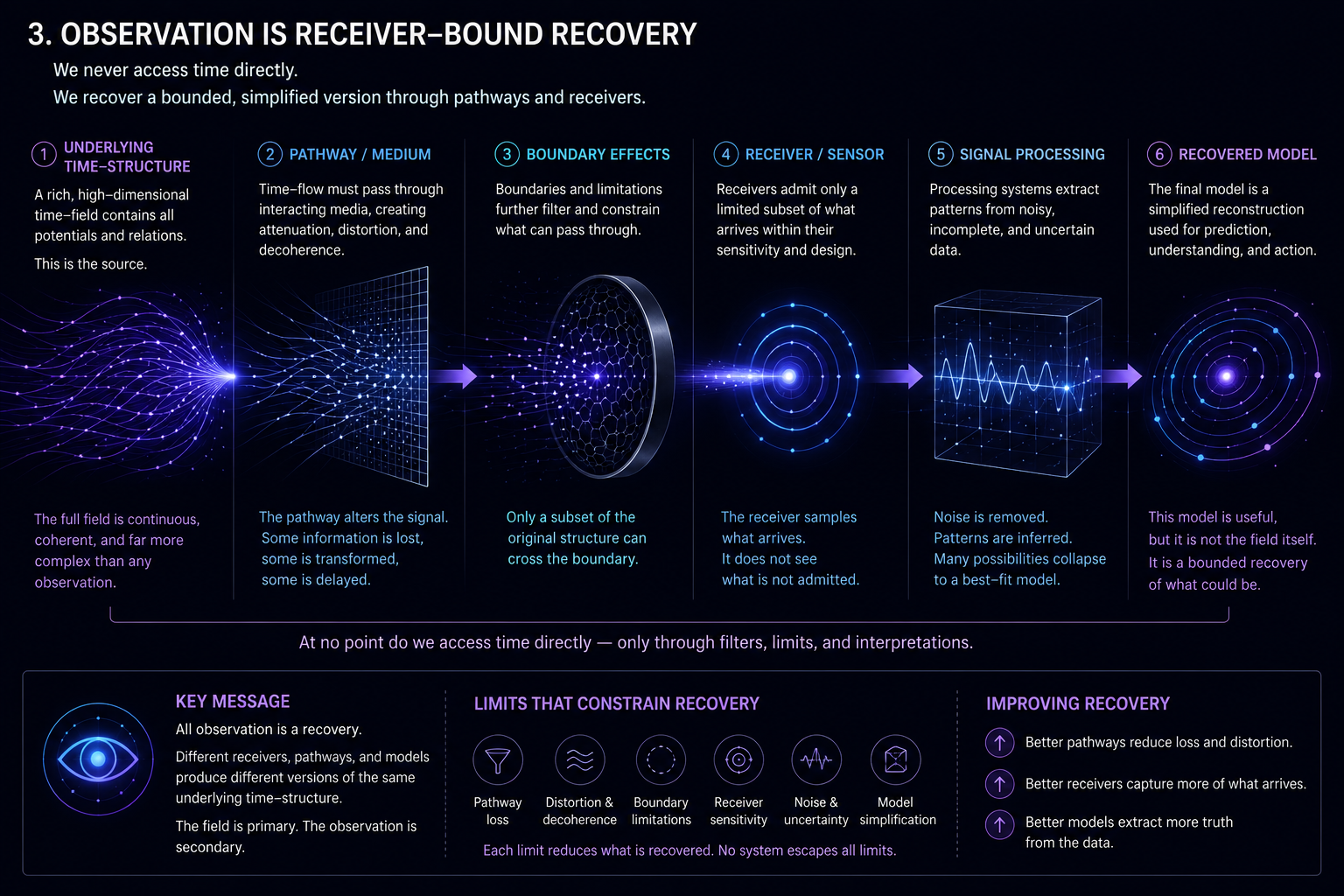
Observation is also different in SCU. A receiver does not access reality directly. It recovers event-memory through a local boundary. Every observation depends on three things: the original event; the pathway through time; the receiver that recovers the surviving structure. This means what appears to an observer is not the full event itself. It is the recoverable remainder of the event after propagation, delay, distortion, coherence loss and receiver filtering. A telescope does not receive a star as it is now. It receives surviving event-memory from a historical energy release. A detector does not receive a photon as a little object that simply travelled through empty space. It recovers a local bounded imprint from time’s flow. A clock does not stand outside time. It is a local chronometric process measuring another chronometric process. This is why SCU treats observation as receiver-based recovery, not direct access to reality.
Why This Matters
Treating time as primitive changes the foundation of physics. It does not throw away standard physics. Standard physics remains the local receiver framework. It describes what we measure inside stable geometry. SCU asks what sits underneath that geometry. It proposes that space, light, gravity, matter, observation and causality are all recoverable structures of time. The universe is not primarily objects moving through a container. It is a chronometric field carrying, shaping and recovering event-memory. The central idea is simple: time is not what happens after the universe exists; time is the field from which the recoverable universe emerges.