Standard Physics Explanation
Standard physics treats observation through instruments, frames, coordinates, measurements and detector outputs.
In General Relativity, observation is usually described using spacetime coordinates, worldlines, light cones, curvature, redshift, clocks and reference frames. An observer measures events from a particular frame, and different observers can disagree about duration, simultaneity, distance and pathway while still being related by the same underlying physical laws.
In quantum physics, observation is tied to measurement, state preparation, probability, detector interaction and outcome selection. A system may be described by a quantum state before measurement, while the detector records a particular result.
In engineering and experimental science, observation is also receiver-bound. Every instrument has a bandwidth, noise floor, resolution, threshold, dynamic range, sampling method and interpretation model. A detector does not record everything. It records what it is built to recover.
These standard descriptions are powerful. They let us build telescopes, cameras, particle detectors, clocks, sensors, antennas, microscopes, interferometers and measurement systems.
SCU accepts the usefulness of these local receiver frameworks. It asks a deeper question:
What is observation recovering?
SCU Explanation
In SCU, observation is not a direct copy of the universe.
Observation is the recovery of event-memory through a receiver boundary.
The observer is inside the chronometric field. Every instrument, clock, detector, material surface, biological eye and nervous system is made from the same time-field it attempts to measure. A measurement is therefore not a view from outside reality. It is an interaction within reality.
This means an observation always involves three parts:
the original event;
the pathway through time;
the receiver that recovers the surviving structure.
The result is not the event itself. The result is the recovered imprint of the event after it has travelled, survived, deformed or lost coherence along its route.
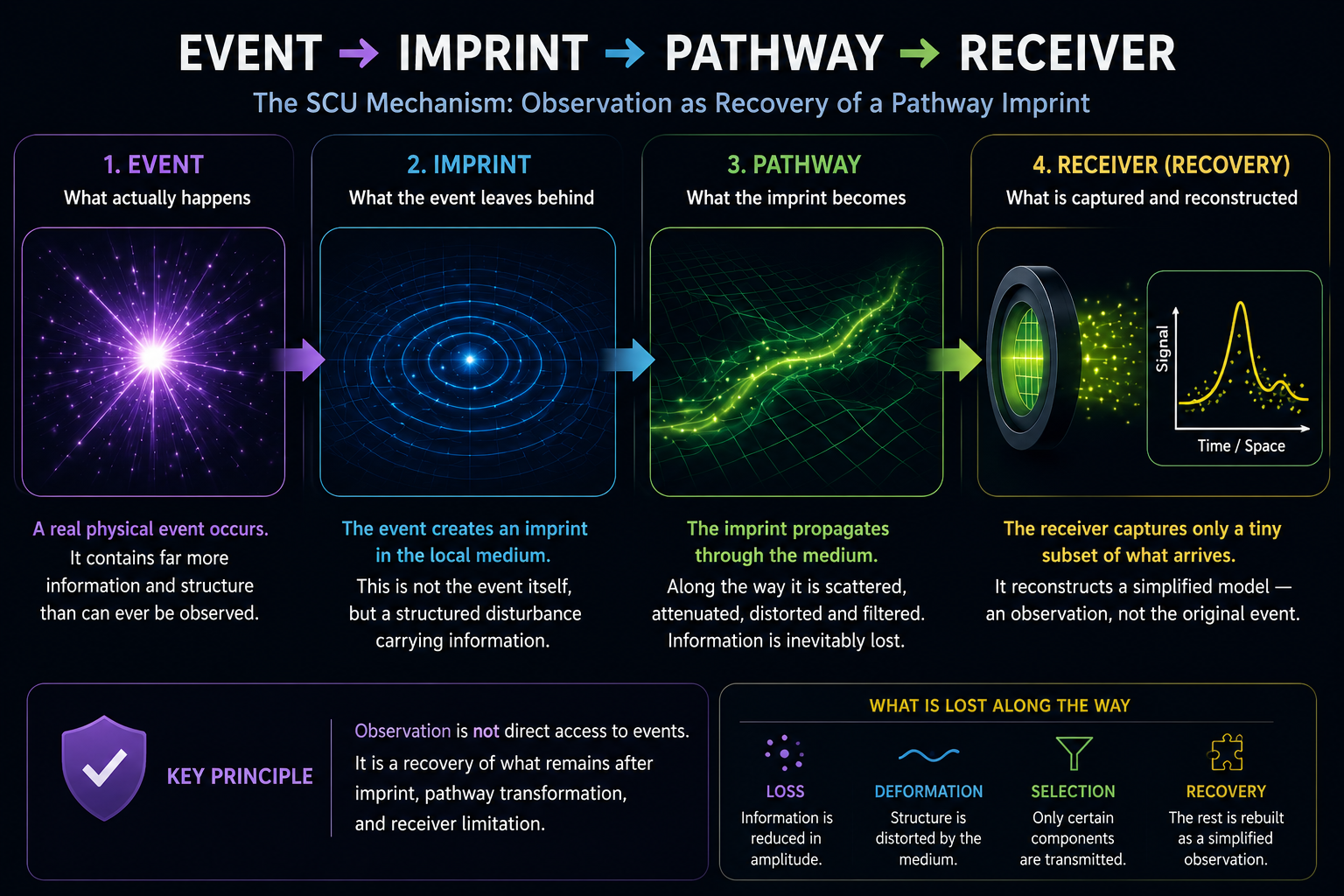
Event, Imprint, Pathway, Receiver
SCU uses a simple sequence:
An event occurs.
The event leaves structure in the chronometric field.
That structure travels as event-memory.
The pathway modifies what survives.
A receiver recovers part of the surviving structure.
The recovered structure becomes the observation.
This applies across physics.
A star emits light. The telescope does not receive the star itself. It receives historical event-memory that has survived a long pathway through time.
An atom changes state. A detector does not recover the original transition directly. It recovers the electromagnetic imprint of that transition as a bounded local event.
A seismic source releases energy. A sensor does not receive the full source event. It receives the surviving waveform structure that reached that sensor through the Earth.
A biological eye does not receive reality unfiltered. It recovers a narrow band of electromagnetic event-memory through a biological receiver.
Observation is therefore not passive looking. It is active recovery.
The Pond Ripple Analogy
The pond ripple analogy also helps explain observation.
A stone enters a pond. The stone impact is the event. The pond carries ripples away from the source. A leaf, wall, sensor or point on the pond does not recover the stone. It only encounters the ripple that reaches it.
That local encounter depends on the original impact, the condition of the pond, the distance travelled, interference from other ripples, boundaries, damping and the sensitivity of the receiver.
SCU treats physical observation in the same way.
The original event is not directly present at the observer. What reaches the observer is a surviving imprint carried through time’s flow. The receiver recovers what its own structure allows.
The observation is real, but it is not complete.
It is a receiver-limited recovery of event-memory.
Receiver Boundaries
A receiver boundary is the interface where event-memory becomes measurable.
For a telescope, the receiver boundary includes mirrors, lenses, sensors, filters, electronics, software and interpretation models.
For a particle detector, it includes material thresholds, interaction probabilities, chamber design, timing, energy sensitivity and signal processing.
For the human eye, it includes the cornea, lens, retina, photoreceptors, neural processing and brain interpretation.
For a clock, it includes the physical process used to mark duration.
For a scientific model, it includes the mathematical assumptions used to interpret measurement.
No receiver is unlimited. Each one preserves some structure and loses other structure.
This is why SCU treats absence carefully. If something does not appear in a receiver, that does not automatically mean it was absent from the underlying event. It may have been outside the receiver boundary, below the noise floor, beyond the coherence horizon, degraded along the pathway or removed by the measurement process.
Observation and Photons
Photon detection is a central example.
In SCU, a photon is the recoverable information imprint of a historical energy-release event carried in time’s flow.
The detector does not catch the original event. It recovers the surviving imprint of that event at a local boundary.
This explains why the same electromagnetic process can appear wave-like or particle-like. During propagation, the imprint behaves like a wave carried through the chronometric field. At recovery, the receiver records a bounded local interaction.
The observed photon is therefore not just a thing arriving. It is a receiver event: a local recovery of historical energy-release information.
Observation and c
Observation also explains why c remains constant locally.
A local observer measures light using clocks, rulers and detectors made from the same chronometric field as the recovered photon imprint. If local time-density changes, the recovered geometry changes with it. The receiver and the light pathway are co-conditioned by the same local state of time.
The observer therefore recovers c locally.
From a wider path-based view, the imprint may have been delayed, redshifted, bent, stretched, scattered or coherence-limited. But the local measurement frame recovers the result through its own local chronometric condition.
This is why SCU separates local measurement from pathway history.
The local measurement can be precise and valid.
The wider pathway may still carry hidden deformation, delay or coherence loss.
Observation and Standard Physics
Standard physics is strong because it defines declared receiver frames.
General Relativity tells us how observations behave inside spacetime geometry.
Quantum physics tells us how measurements behave inside detector interaction and probability frameworks.
Signal theory tells us how information survives noise, bandwidth and sampling limits.
SCU does not discard these tools. It expands the question.
Instead of asking only what the receiver measured, SCU asks:
what event produced the recoverable imprint;
what pathway carried it;
what changed during propagation;
what did the receiver preserve;
what did the receiver lose;
what structure may exist outside the declared measurement frame.
This is the receiver-expanded view of observation.
What Appears and What Is Lost
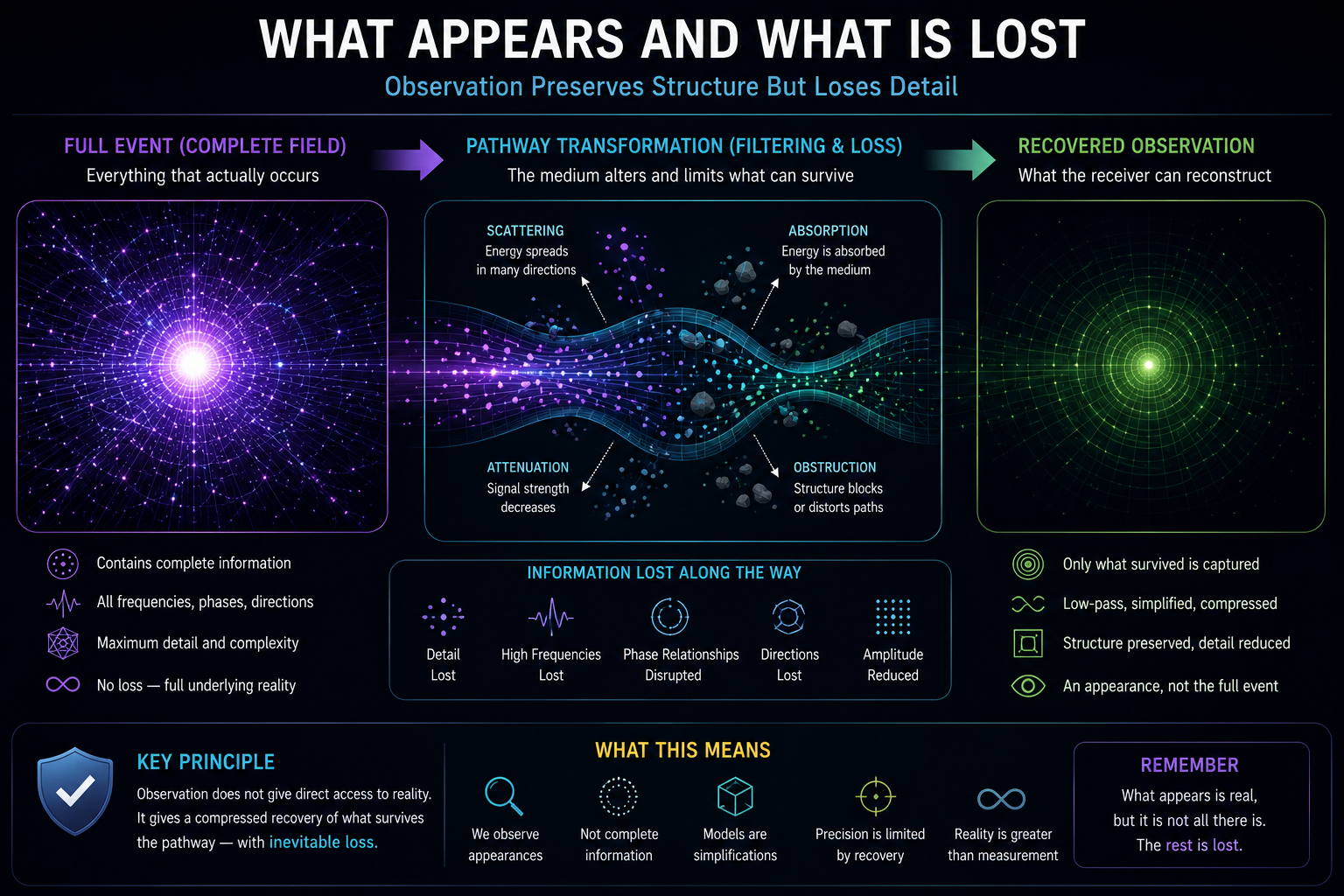
Every observation has a visible part and a lost part.
The visible part is the structure recovered by the receiver.
The lost part may include phase structure, weak coherence, sub-noise organisation, pathway distortion, boundary information, historical source detail or structure outside the receiver’s operating band.
This matters because science often treats the measured result as if it were the whole event. SCU warns against that shortcut.
The measured result is not false. It is real. But it is receiver-bound.
A clean measurement may be clean only inside the receiver’s declared frame.
A missing signal may be missing only to that receiver.
A particle-like event may be the local recovery of a wider wave-like imprint.
A redshift may contain both source information and pathway history.
A detector output may hide the structure that was lost before detection.
Observation is therefore evidence, but it is not total access.
Summary
In SCU, observation is receiver-based chronometric recovery.
The universe is not copied directly into a measurement. Events leave imprints in time’s flow. Those imprints travel through pathways. Pathways preserve, distort or erase structure. Receivers recover part of what survives.
What appears is the recovered event-memory.
What does not appear is not automatically absent.
It may be outside the receiver boundary, beyond the coherence horizon or lost along the route.
Observation is therefore not simply seeing.
It is the local recovery of history from time.